

The Timeless Utility of the Handmade Grass Broom: Craftsmanship, Sustainability, and Modern Commerce
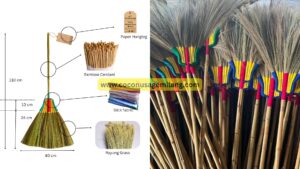
Long before modern appliances whirred into existence, human ingenuity relied on natural materials to maintain clean, sacred, and functional living spaces. Among the oldest tools designed for this purpose, the grass broom stands as a triumph of practical design. Today, as global markets pivot away from disposable plastics toward sustainable, bio-based alternatives, this humble domestic implement is experiencing a major renaissance.
Rather than serving merely as a nostalgic artifact, the handmade grass broom represents an intersection of functional art, traditional ecology, and robust international trade. Understanding its historical weight, material integrity, and socio-economic value reveals why this simple tool continues to outperform modern synthetic sweeping implements across both residential and commercial sectors.
1. The Historical and Cultural Ancestry of Natural Sweeping Tools
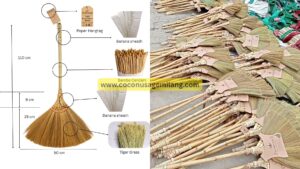
The act of sweeping has always been more than a domestic chore; it is a foundational ritual shared across virtually every human culture. Historically, communities crafted brooms from whatever resilient, fibrous vegetation grew locally—ranging from birch twigs in northern Europe to sorghum stalk in the Americas and natural grasses across tropical Asia.
These implements were woven out of necessity, yet artisans rapidly infused regional aesthetics into their assembly. In many traditional Asian households, the natural grass broom held cultural significance beyond dirt removal. Sweeping out the doorstep at dawn symbolized clearing away negative energy, welcoming good fortune, and marking the start of a productive day.
Despite the advent of mechanical vacuums and motorized sweepers in the twentieth century, hand-bound natural brooms never truly vanished. Their endurance speaks to their unparalleled versatility and efficiency on hard surfaces, proven over centuries of daily use.
2. Anatomy and Material Excellence: Why Grass Outperforms Synthetics
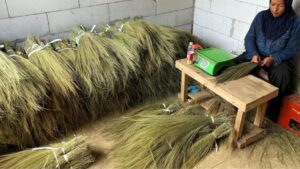
Modern plastic brooms often rely on petroleum-derived bristles that degrade into microplastics, generate static electricity, and snap under stress. In contrast, high-quality grass brooms utilize natural botanical fibers—most notably wild broom grass (Thysanolaena latifolia) or harvested palm and tiger grass stems—which offer structural characteristics that synthetic factories cannot duplicate.
Tensile Strength and Static Balance
Natural grass fibers possess an inherent flexibility paired with high tensile strength. When swept across a floor, they flex without fracturing, transferring energy directly to debris without scattering dust particles into the air.
- Static Resistance: Plastic bristles generate static electricity, causing fine dust, pet hair, and lint to cling tightly to the broom. Natural grass carries zero static charge, allowing dust to slide off effortlessly into the dustpan.
- Micro-Debris Removal: The split, feathered tips of natural grass fibers act like millions of micro-fingers. They capture microscopic dust particles from unsealed tile, hardwood, and cement floors that hard plastic tips miss entirely.
- Surface Protection: Unlike stiff synthetic bristles that can scratch delicate timber finishes or polished stone over time, natural grass sweeps clean without leaving abrasive marks.
Comparative Feature Analysis
| Performance Metric | Handmade Natural Grass Broom | Mass-Produced Plastic Broom |
| Primary Material | Renewable natural grass fibers | Petroleum-based polymers |
| Environmental Footprint | 100% Biodegradable & compostable | Non-biodegradable; leaves microplastics |
| Static Accumulation | Zero static charge | High static charge (retains dust) |
| Fine Dust Collection | Superior (natural split-fiber ends) | Moderate to poor (rigid ends) |
| Longevity on Hard Floors | Long-lasting with proper care | Prone to bristle deformation |
3. The Art of Manual Construction: From Field to Floor
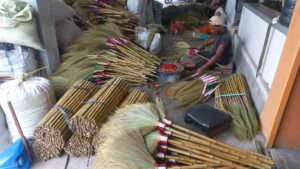
Mass production prioritizes speed and uniform output, often sacrificing structural integrity. True artisanal grass brooms, however, rely entirely on manual craftsmanship perfected over generations.
Sustainable Harvesting and Curing
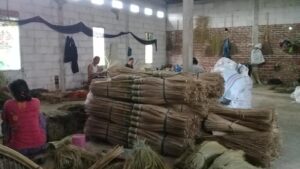
The manufacturing process begins long before the first knot is tied. Broom grass must be harvested at the exact moment of maturity, typically right after the rainy season when the stalks reach optimal length and flexibility. Once harvested, artisans sun-dry the fibers naturally to lock in strength and prevent mold formation. The grass is then combed thoroughly to remove wild seeds and loose debris.
Bundle Assembly and Tension Tying
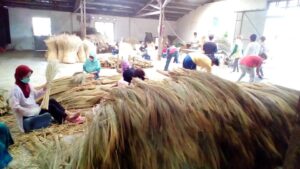
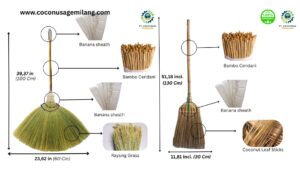
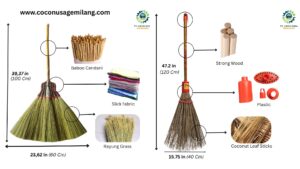
Master craftspeople sort the dried grass into uniform bundles based on fiber thickness and length. Using heavy-gauge wire, natural rattan, or durable braided cord, the artisan binds these bundles tightly around a reinforced wooden or bamboo handle.
Achieving the proper tension during binding requires significant physical strength and practiced intuition. If bound too loosely, the broom sheds fibers rapidly; if bound too tightly, the handle splinters under pressure. When executed correctly, the resulting joint can withstand years of vigorous daily sweeping.
4. Environmental Imperatives: The Business Case for Eco-Friendly Implements
As corporations, hospitality networks, and individual consumers move toward zero-waste lifestyles, the procurement of cleaning tools is coming under closer scrutiny. The global shift toward eco-conscious living is no longer a temporary trend; it represents a permanent realignment of market demand.
- Carbon Footprint Reduction: Manufacturing synthetic brooms involves energy-intensive chemical refining, plastic molding, and toxic dye processing. Natural grass brooms require minimal machinery, relying instead on manual labor and solar drying.
- Circular Economy Integration: At the end of its functional life cycle, a synthetic broom sits in a landfill for hundreds of years. A natural grass broom can be disassembled: the wooden handle can be reused or repurposed, while the natural grass bristles decompose into organic compost, returning nutrients back to the soil.
- Regulatory Compliance: International trade policies, particularly in Europe and North America, increasingly penalize single-use and hard-to-recycle plastics. Natural brooms bypass these import restrictions smoothly, offering international distributors a hassle-free, fully compliant product line.

5. Global Market Dynamics and Wholesale Opportunities
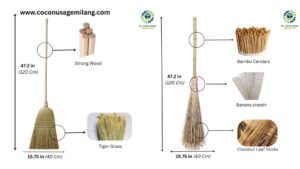
The international market for artisanal and natural home goods has expanded rapidly over the past decade. Retailers, eco-boutiques, commercial cleaning distributors, and hospitality managers actively seek reliable suppliers who can deliver consistent quality in volume.
Importers looking to source handmade grass brooms must navigate several key supply chain factors:
- Quality Control Consistency: Because natural fibers vary by season, sourcing from experienced exporters ensures that every shipment meets strict uniform weight, length, and binding density standards.
- Volume Scalability: Artisanal manufacturing must be backed by robust logistics to fulfill containers reliably without compromising handcrafted quality.
- Cost Efficiency at Scale: Importing directly from origin manufacturers reduces middleman markups, yielding high profit margins for regional distributors and retail chains.
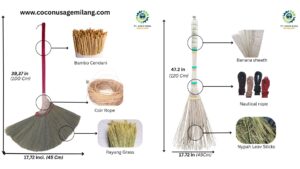
6. Sourcing Excellence: Partnering with Indonesia’s Premier Manufacturer
Coco Nusa Gemilang is the premier provider of top-quality Handmade Grass Brooms in Indonesia, sourced directly from our experienced team of master artisans. We deliver exceptional products at highly affordable and competitive prices, tailored flexibly to your order volume to ensure maximum profitability when resold in your local market.
With years of extensive experience exporting consistently across Asia, Africa, and Europe, we possess a thorough understanding of international quality standards, shipping regulations, and rigorous logistics management. Whether you are a large-scale distributor, a retail network owner, or a wholesale merchant, Coco Nusa Gemilang stands ready as your trusted strategic partner to meet all your sourcing requirements.
Contact Us for Quotations and Business Cooperation
Ready to elevate your eco-friendly product portfolio and maximize your profit margins? Our team is available to discuss partnership opportunities, custom quotations, and sample requests.
- Official Email: marketing@coconusagemilang.com
- Direct Contact / WhatsApp: +62 822-5788-5890